
Wondering how much to charge for membership of an association? The question comes up every year, whether the organization is just starting out or revising its articles of association.
No law imposes an average membership fee for an association: each association freely sets its membership fee. Two things guide this choice in practice: the costs the membership fee must cover over the year, and the categories of members the organization wishes to distinguish.
To help you see more clearly, this article, written by the experts behind our customizable CRM, brings together typical association membership fee amounts sector by sector, the 3 most common calculation methods and the points to lock down in your articles of association.
- The law imposes no membership fee for an association: the amount is set freely in the articles of association.
- 3 methods exist: fixed amount, proportional rate or mixed formula.
- Offering reduced rates (students, retirees, families) remains a common and appreciated practice.
- A membership fee paid to a public-interest association entitles the member to a tax reduction.
- A centralized management tool eliminates forgotten payments and sends reminders for you, giving time back to the treasurer.
Who sets the amount of the membership fee?
The amount of an association membership fee is never imposed by an outside body: it is the association’s articles that designate the body responsible for setting it, and that same body decides each year.
Depending on the size of the organization and the structure set out in its articles, 3 bodies can be given this responsibility:
- The board, for the smallest organizations or routine decisions.
- The board of directors, when an intermediate governance level exists.
- The general meeting, often to approve or revise the association’s membership fee each year.
The amount set in the articles of association
In practice, the articles rarely state a specific amount. Leaving it out avoids having to amend them, with the procedure that entails, every time the fee is revised. They do, however, set two things: the body responsible for deciding and, most often, the calculation principle adopted, whether a single amount, rates by member category or a proportional scale.

The role of the general meeting or the board
This vote generally takes place at the same time as the presentation of the accounts, which makes it the natural moment to explain what the previous year’s membership fees were used for. This transparency about the use of funds often weighs as much as the amount itself in how an increase is received.
Our observations: in the associations we support, the fee question almost always comes up at the same time, when memberships are renewed. A stable amount from one year to the next reassures members, and an increase is generally well accepted provided it is explained before the vote rather than announced afterwards.

Average association membership fee: amounts observed by sector
The typical amounts observed vary markedly from one sector to another, because the costs covered are not comparable between a sports club that insures its members and a mutual aid organization largely funded by donations. The table below provides benchmarks to position your own association before settling on an amount.
| Type of association | What the fee covers | Typical amount observed |
|---|---|---|
| Local sports association | Insurance, coaching, equipment | A few dozen euros per year |
| Cultural or leisure association | Venue, activities, projects | Moderate amount, often varying by activity |
| Training provider or professional body | Professional resources, monitoring, network | Annual fee, sometimes by member category |
| Humanitarian or mutual aid association | Operations, field activities | Free amount, often supplemented by donations |
Membership fee or donation: what changes for the member’s tax benefit
The membership fee funds the association’s day-to-day operations; a donation, on the other hand, is an act of generosity, with nothing expected in return. This distinction matters, as it determines the tax benefit a member can claim.
According to service-public.fr, a membership fee paid to a public-interest association entitles the member to a tax reduction of 66% of the amount paid, up to 20% of taxable income. Note that any excess can be carried forward over the following 5 years.
In short, what to remember from a tax perspective:
- The reduction amounts to 66% of the membership fee for a public-interest organization.
- The ceiling is 20% of the member’s taxable income.
- Simple benefits such as voting rights or access to information documents do not affect this benefit.
- An item given in return is still allowed if it does not exceed €65 or a quarter of the amount paid.
Simplifying membership fee tracking with a suitable management tool
Tracking payment status, chasing late payers, issuing receipts: this administrative work quickly weighs on a small volunteer team or a dedicated staff member.
Good news: we designed Cirrus Shield so that this tracking no longer relies on a spreadsheet or on the treasurer’s memory.
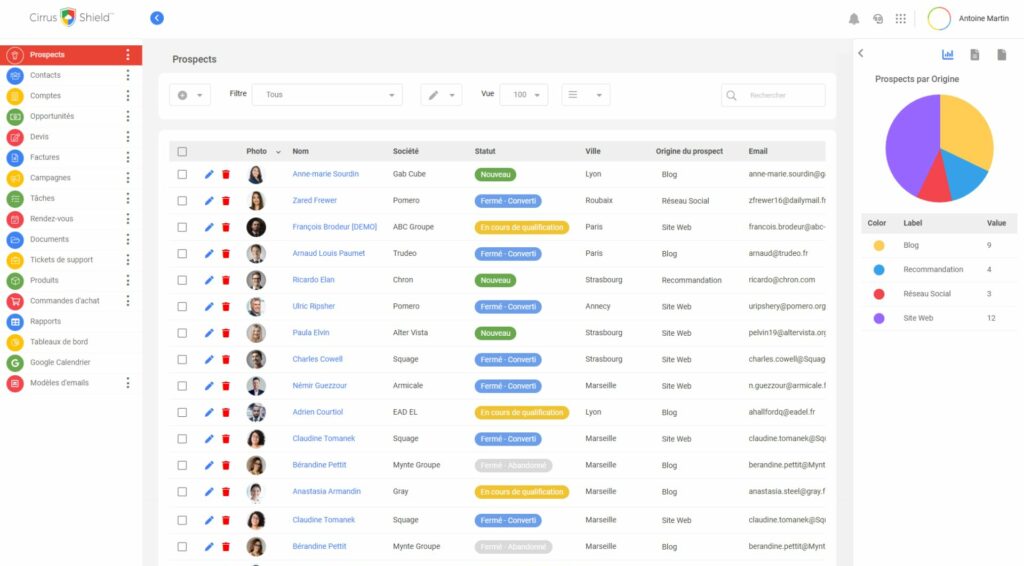
Thanks to its low-code approach, each association builds its own membership journey, from the first payment to automatic renewal, without writing a line of code. Among associations that bring their management together in one place, 3 benefits come up most often:
- Up-to-date tracking of membership fees, visible at a glance for the whole board.
- Automatic reminders sent to members before the due date.
- A complete history, useful for preparing the general meeting without re-keying.
“What our association customers ask us for first is to stop chasing late payments. An automatic reminder completely changes a volunteer treasurer’s daily life,” sums up the Cirrus Shield team.
Looking to make your membership fee tracking more reliable without adding to your workload? With Cirrus Shield, every payment, reminder and receipt stays centralized in one place, without juggling several files.
FAQ – Average association membership fee
Is a membership fee mandatory to join an association?
No, no law requires a membership fee: it remains optional, unless the association’s articles explicitly make it a condition of membership.
How do you set the membership fee for a new association?
Start from the actual costs to be covered (insurance, equipment, premises), then choose between a single amount or a scale by member category, before writing it into the articles.
Can you deduct your membership fee from your taxes?
Yes, if the association pursues a public-interest purpose and provides no substantial benefit in return, the membership fee entitles you to a 66% tax reduction, up to 20% of taxable income.
Can an association offer different rates depending on the member?
Yes, the articles can provide for reduced rates for students, retirees or families, provided the categories chosen remain objective and clearly defined.
What happens if a member does not pay their membership fee?
The articles or internal rules generally specify the possible consequences: a simple reminder, loss of voting member status, or even removal after a period set in advance.
What is the difference between a membership fee and a donation to an association?
The membership fee grants member status and funds day-to-day operations, while a donation is a free gesture of support, unrelated to any status or anything in return.
- Cotisations (Membership fees), Associations.gouv.fr
- Dons aux associations et réduction d’impôt (Donations to associations and tax reduction), Service-Public.fr
- La France associative en mouvement (The French non-profit sector in motion), Associations.gouv.fr

