
Poorly managing your quotes is like throwing money out the window. For a VSE, every proposal sent carries significant weight. Between a hesitating client, a competitor who hits back fast, and a project looming on the horizon: everything often comes down to the quality of the document provided.
Yet, many entrepreneurs view quoting as an administrative chore. This is a mistake. For a small organization, the quote is the backbone of the sales strategy. It reveals the margin, validates future cash flow, and kicks off project tracking
- The quote is the first link in a VSE’s sales chain, and 68% of construction clients choose the contractor who is first to provide a clear document.
- In the construction industry, a quote becomes mandatory for any amount starting at €150 (including VAT) and must include twelve legal disclosures; failure to comply can result in fines of up to €15,000 per company.
- The main pitfalls are slow drafting times, calculation errors, a lack of structured follow-ups, and the absence of centralized visibility over opportunities.
- Best practices include standardizing templates, detailing each service provided, using unique numbering, and setting a validity period limited to 30 or 60 days.
- A CRM like Cirrus Shield centralizes quotes, invoicing, follow-ups, and cash flow, with pricing starting at €25 per user, per month.
- La facturation électronique devient obligatoire en réception dès septembre 2026, puis en émission pour les TPE et artisans à partir de septembre 2027.
The quote: the first link in the sales chain
The quote sets the stage for the relationship between a company and its client. Everything starts there. The creation of the document, its delivery, the prospect’s signature: every stage shapes what follows. Whether it’s a VSE in construction, a solo contractor, or a software publisher, they all share this same starting point.
According to construction industry data, 68% of clients choose the contractor who is the first to fire off a clear quote. Striking while the iron is hot remains the rule. A quote sent within 24 hours is often worth more than a perfectly crafted document received two weeks later.
This reality hits construction contractors particularly hard. However, it also applies to service-based SMEs, consultants, and independent entrepreneurs. Speed is paramount, but not at the expense of accuracy
Mandatory disclosures: a necessary requirement
An improperly calibrated quote exposes its author to penalties. In the construction industry, a quote is mandatory for any amount starting at €150 (including VAT). Twelve mandatory disclosures must be included: full contact details, SIRET (business registration number), address, detailed breakdown of the work, unit prices, validity period, and many others
Construction contractors must also disclose their ten-year liability insurance (assurance décennale) and attach the certificate. A single oversight is costly: up to €3,000 for an individual and €15,000 for a company, per missing disclosure. This is enough to seriously strain the budget of a small organization
These obligations aim for transparency toward the client. They also protect the entrepreneur by clarifying the scope of the agreed-upon work. Once signed, the quote becomes an enforceable contract—valuable in the event of a dispute regarding material purchases or secondary expenses.
The pitfalls weighing down VSEs
Several recurring issues constantly plague quote management for small businesses. Simply identifying them already helps defuse half the problem.
First, there is slowness. Lacking pre-set templates, the business owner drafts every quote by hand. Three hours lost in the evening, a late response, and the project slips away to a competitor. Overwhelmed contractors know this all too well.
Next, calculation errors. A poorly applied discount, an approximate VAT calculation, or an oversight on material purchases: the margin evaporates even before the signature is dry. On an €8,000 quote, a two percent discrepancy represents a net loss of €160
Follow-up often falls short as well. How many sent quotes are just sitting dormant in a prospect’s inbox? Without organized follow-ups, the conversion rate drops heavily. Solo contractors frequently fall into this trap
Finally, there is the lack of visibility. An approved quote should trigger the invoice, cash flow tracking, and project organization. Without a centralized tool, the VSE is essentially flying blind.
Best practices for structuring quote management
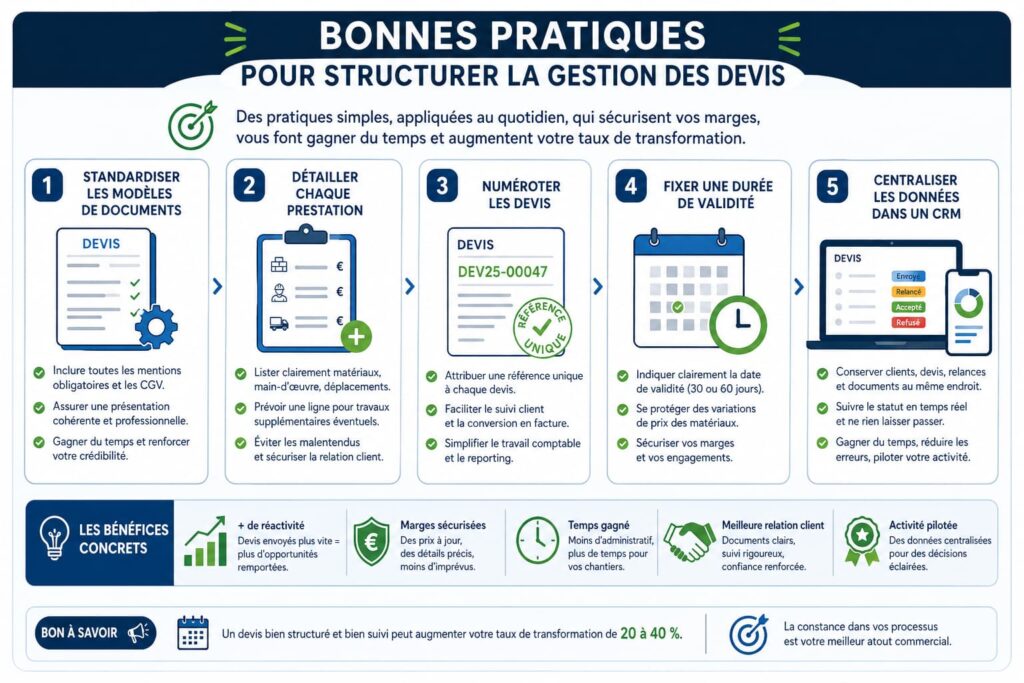
A few simple rules can get the ship back on course. Templates, details, numbering, validity periods: every brick added to the foundation strengthens the sales process.
A few simple rules can get the ship back on course. Templates, details, numbering, validity periods: every brick added to the foundation strengthens the sales process.
Standardize Document Templates
A master template, equipped with all mandatory disclosures and general terms, shortens the creation of each new quote. Contractors gain consistency and credibility. Time spent on sales decreases, while time dedicated to the job site increases.
Detail Every Service
Materials, labor, travel: every line item should speak for itself. A line dedicated to potential additional work—subject to prior client approval—prevents unpleasant surprises on-site. This level of precision protects the relationship and shortens negotiations.
Number the Quotes
A unique reference connects every proposal to a client and an opportunity, and eventually to an invoice. The accounting department, whether internal or outsourced, can then track everything down without wasting a minute.
Set a Validity Period
Material prices fluctuate. Limiting a quote to 30 or 60 days avoids having to honor an obsolete rate six months later. This keeps margins secure.
Centralize Data in a CRM
Manual quote management in a VSE quickly reaches its limits. Scattered spreadsheets, emails drowned in an overloaded inbox, documents lost on a desk: fragmentation ruins the business. A CRM brings all of this into one place.
Sales management software stores client data, interaction history, and the status of every quote. Creating a new document then takes just a few clicks. Information—such as billing addresses, contacts, and negotiated terms—is pulled directly from the client profile.
This centralization frees up time. Costs associated with double data entry disappear, as do errors. Modern tools also offer a mobile view, accessible from the job site or during client meetings—practical for approving a quote on the spot and closing the sale without warning.
Cirrus Shield: A CRM Tailored for VSEs and SMEs
Among the solutions on the French market, Cirrus Shield deserves the attention of VSE and SME managers. This French, customizable, low-code CRM covers the entire sales process, from prospect to payment.
Regarding quote and invoice software, Cirrus Shield offers one-click creation directly from the opportunity. The document automatically retrieves billing addresses, delivery addresses, and contact details. No re-entry, no oversights. The status of the quote can be tracked at a glance thanks to a dedicated process view.
Once the quote is approved, the invoice is also generated in a single click. Product lines, prices, and discounts are transferred to the accounting document. Integration with Stripe allows clients to pay online using several payment methods. Payment status and outstanding balances are displayed in real-time within the user interface.
Workflow automation is another key strength. Confirmations, payment reminders, and the creation of sessions from an approved quote are all tasks handled without human intervention. This frees the manager for higher-value missions.
Cirrus Shield adapts to many sectors: construction, real estate, training organizations, and business services. The solution molds itself to business processes without the need for an external provider. Pricing starts at €25 per user per month, with Enterprise and Ultimate tiers for more demanding organizations. Features are managed from the admin side without a single line of code.
Follow-ups: The Sinews of War
A sent quote is not a signed quote. Structured follow-ups make all the difference. Statistically, two out of three clients end up signing after a polite follow-up within seven days. Without tracking, the conversion rate drops below 30%.
Modern software handles these follow-ups through automated workflows. A scheduled email three days after sending, a phone call noted in the CRM on the seventh day, and a final proposal on the fifteenth: the cadence is set once and for all.
For overwhelmed contractors, this mechanism is a game-changer. Quotes no longer fall into oblivion. Revenue grows mechanically, without additional effort in front of the client.
Electronic Invoicing: Heading Toward 2026 and 2027
Electronic invoicing is becoming unavoidable. The official French timeline mandates that all companies must be able to receive electronic invoices starting in September 2026. The obligation to issue them will extend to VSEs, contractors, and micro-entrepreneurs in September 2027.
The Factur-X format—a hybrid of PDF and structured data—is emerging as the gold standard. Its compatibility with major management software eases the transition. Adopting a compatible tool now avoids a last-minute scramble.
Recent CRMs, with Cirrus Shield at the forefront, already integrate these formats. Invoices issued from the platform meet regulatory requirements without extra handling. This allows businesses to approach the deadline with peace of mind rather than with their backs against the wall.
Tracking Cash Flow Once the Quote is Signed
A signed quote is only a promise. Until the final invoice has been paid, cash flow remains in limbo. Therefore, tracking collections completes quote management for a VSE.
A good tool displays pending invoices, delays, and outstanding balances in real-time. Automated reminders limit unpaid bills—a classic scourge for construction contractors. On a job site, the gap between material expenses and collections can create a financial hole in just a few weeks.
Cross-referencing quote, invoice, and payment data provides a clear view of the actual margin per project. The manager then steers the business based on tangible figures rather than impressions. This is the direct benefit of a correctly configured CRM.
Choosing the Right Tool at the Right Time
Choosing the best software to manage quotes depends on the size of the VSE, the sector, and the budget. Some tools provide free support for starting freelancers. Other, more comprehensive solutions support growth toward becoming an SME.
A CRM like Cirrus Shield combines quotes, electronic invoicing, automated follow-ups, cash flow tracking, and mobile access. For entrepreneurs eager to professionalize their business without getting bogged down, it is a solid compromise.
All that remains is to get to work: sort through current quotes, formalize templates, select a suitable tool, and train the team. These are all steps that deserve…

