
Setting up a training organisation is quick. Staying compliant is less so. Once the activity is declared, a series of obligations applies, and forgetting them comes at a price: a fine, lapse of the declaration number, loss of access to funding.
Here are the legal obligations of a training organisation, in the order in which they apply to you, with what is actually checked in an inspection.
The team behind our CRM for training organisations tells you everything.
- Activity declaration within three months of the first agreement or contract.
- Educational and financial report (BPF) every year, on pain of a fine and lapse of the number.
- Separate accounting for the training activity if you carry out other activities.
- Internal rules are mandatory, given before final enrolment.
- Qualiopi is not mandatory to operate, only to access public and pooled funds.
1. The activity declaration
This is the first obligation, and it has a precise trigger: you have three months from the signing of your first agreement or training contract to file your activity declaration. Not from the creation of the company.
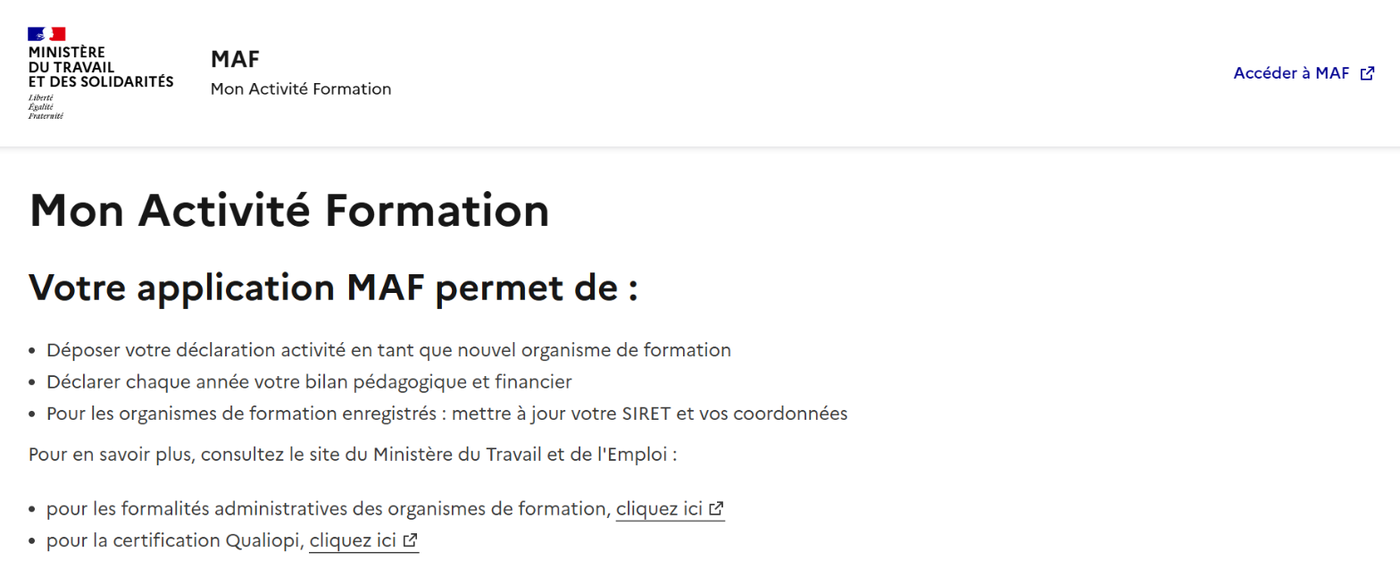
Filing is done with the DREETS, the regional directorate for the economy, employment, labour and solidarity, which replaced the Direccte on 1 April 2021. The procedure goes through the “Mon Activité Formation” online service. In return you obtain your eleven-digit activity declaration number, the NDA.
A useful clarification: this number is not an approval and does not amount to any recognition of quality. The regulations also govern how it may be cited, requiring the statement “This registration does not constitute State approval”. Presenting it as a guarantee of seriousness is therefore to be avoided, in your materials as on your website.
2. The educational and financial report
The BPF applies to all declared organisations, not only those that receive public funds. This is the most widespread mistake on the subject.
It reports the training activity of the closed financial year: actions carried out, hours, headcount, origin of income and nature of expenses. The campaign takes place in spring, on “Mon Activité Formation”, with the exact dates published each year by the DREETS.
The penalty is twofold, and it is the second that hurts: a warning or an administrative fine of up to 4,000 euros, and above all the lapse of your activity declaration. In other words, you lose your number and have to start all over again.
A BPF is prepared all year round, not in spring. This is precisely what centralized tracking of sessions, headcount and funders makes easier, a subject we cover in our article on the administrative management of a training organisation.
3. Contractual documents
Two documents exist, and they do not apply to the same buyers. Confusing them is a frequent non-compliance.
The training agreement
It applies when the buyer is a legal entity: a company, an OPCO, a public funder. This is the most common case in professional training, hence the importance of respecting the mandatory mentions of the training agreement.
The vocational training contract
It applies when an individual finances their own training. Two rules are added, often overlooked. The trainee has a ten-day withdrawal period from signing, extended to fourteen days for a contract concluded at a distance. And no sum may be demanded before this period expires; after that, the payment is capped at 30% of the price.
Collecting a deposit on the day of signing from an individual is therefore irregular, even with their agreement.
4. The internal rules
Mandatory for every training organisation. They set the hygiene and safety rules, the disciplinary rules, the procedure applicable in case of sanction and the arrangements for trainee representation for long courses.
A point of vigilance: they must be brought to the trainee’s attention before final enrolment and before any payment. Attaching them to the file afterwards is not enough.
5. Accounting obligations
On top of the accounting obligations common to every business comes a requirement specific to the sector, and it is regularly checked.
If training is not your exclusive activity, you must track the training activity separately: separate accounting, dedicated sub-accounts or analytical accounting. The aim is to be able to isolate training income and expenses. Since the law of 25 June 2026, a breach exposes you to a warning or an administrative fine of up to 4,000 euros per breach.
A clarification that circulates wrongly: a sole trader does not have to file annual accounts with the commercial court registry. That obligation applies to companies, not to a standard sole proprietorship.
6. GDPR, correctly understood
You often read that you must “obtain consent” before collecting data. This is inaccurate, and this mistake needlessly complicates enrolments.
Consent is only one of the six legal bases provided for by Article 6 of the GDPR. To enrol a trainee, issue an agreement and deliver a certificate, the relevant basis is performance of the contract. Consent becomes necessary again for what goes beyond that performance, typically later commercial prospecting.
What remains mandatory in all cases: informing people, keeping a record of processing, defining retention periods, securing data and knowing how to respond to an access or erasure request. The subject is detailed in our article on GDPR and your CRM data.
7. Qualiopi: mandatory, but not for everyone
Qualiopi is a certification, issued by an accredited certification body, and not a label or a qualification. It is not necessary to operate: it conditions access to public and pooled funds, which in practice concerns most organisations.
The framework rests on seven criteria: public information, design of services, adaptation to audiences, teaching and support resources, staff qualification, integration in the professional environment, and collection of feedback and complaints.
A deadline to note: decree no. 2026-728 of 1 August 2026 raises the framework from 32 to 33 indicators, applicable from 1 November 2026. The seven criteria do not change, the evidence requirements do.
8. What is often forgotten
- Prior information for the trainee: objectives, prerequisites, duration, assessment methods, prices, accessibility. It also conditions the first Qualiopi criterion.
- The disability officer and information on the accessibility of courses.
- Professional liability insurance, to be checked in particular if you receive the public on your premises.
- Regulation of subcontracting: contracting, checking the subcontractor’s declaration, the principal’s responsibility.
- Inspection by the regional inspection services attached to the DREETS, which can demand repayment of funds and pronounce bans on operating.
The common point of all these obligations is proof. None is satisfied by an undocumented good practice. This is what makes centralized tracking pay off well before the first audit.
Your questions about the obligations of a training organisation
What happens if I carried out no training this year?
The BPF is still due, at zero. An absence of activity does not exempt you from the declaration, and a report showing no training can make your declaration lapse, just like a report not submitted.
Can I start without an activity declaration number?
Yes, the declaration comes after the first agreement. The three-month period runs from its signing, not from the creation of the business.
Do you need Qualiopi to sell to a company?
Not if it pays from its own funds. As soon as an OPCO or a public funder is involved, certification becomes essential, and that is the most frequent case.
How long should documents be kept?
Align with accounting retention periods and funders’ requirements, which are generally longer. Attendance sheets are the documents most requested in inspections, so keep them carefully.
Is software enough to be compliant?
No, and beware of promises to the contrary. A tool produces and keeps the evidence, it does not decide your practices or replace reading the framework.

