
Managing the customer experience first requires knowing it. Two tools serve this purpose, and they complement each other: the customer experience map (customer journey map), which describes a journey, and the typical profile, or persona, which describes the person who follows it.
Here is how to build them, what they are really for, and the mistake that turns them into decorative documents.
The team behind our flexible, automatable CRM tells you everything.
- The experience map represents the journey over time: before, during and after.
- Moments of truth are the stages where everything is decided: that is where you need to act.
- Three dimensions not to forget: social, sensory, emotional.
- The persona is built on behaviors, not on demographic criteria.
- A document never tested against the field only describes your assumptions.
The customer experience map
Originating in marketing, it consists in identifying and then representing in chronological order the interactions between a customer segment and your product, service or organization.
The focus is on the customer, not on you: their needs, their actions, their emotions, throughout the journey. The goal is to identify the moments of truth, the stages where the relationship tips one way or the other. Each one then makes it possible to remove an obstacle or create an action.
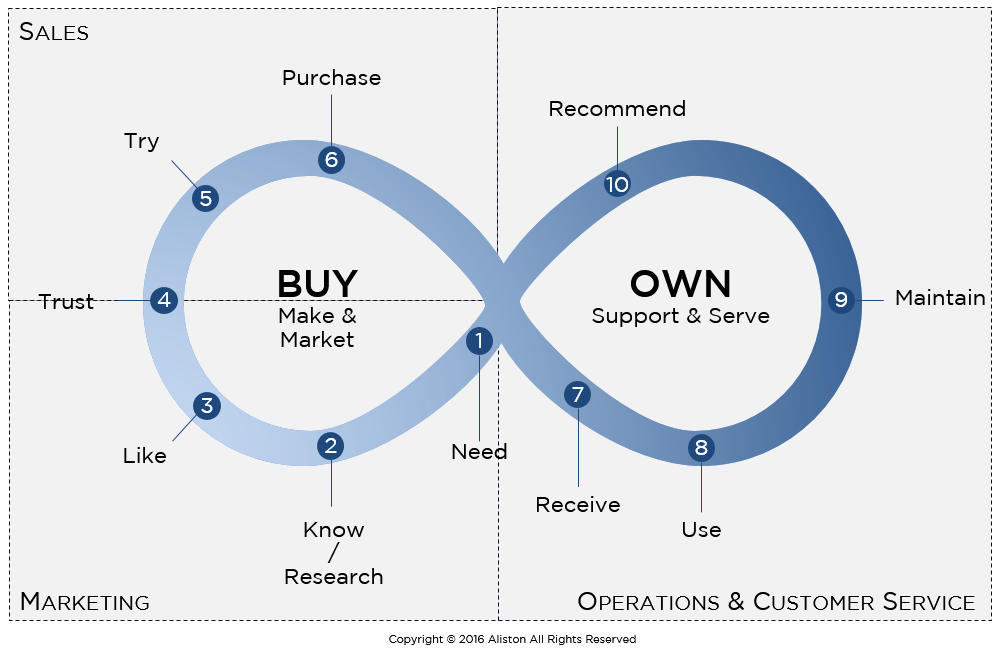
This diagram illustrates one possible breakdown into ten stages, split across two loops. The first goes from need to purchase and falls under marketing and sales: the customer identifies a need, looks for information, becomes interested, trusts, tries, then buys. The second goes from receipt to recommendation and falls under operations and customer service: they receive, use, maintain the relationship, then recommend.
The useful reading of this diagram fits in one sentence: the right half is the one most companies neglect, even though it produces recommendations, and therefore part of the left half for the next customer.
The structuring elements
- Duration: it helps understand the state of mind in which the customer enters and leaves each interaction.
- Stages: choose the ones you really want to analyze, rather than representing everything.
- Intensity: to visualize, at each touchpoint, the strength of the emotion felt.
The three dimensions of experience
- Social: what the customer does, with whom, in what relational context.
- Sensory: what they concretely perceive of the experience, and the effect produced.
- Emotional: their state of mind, taking into account what came before, a previous disappointment or an ongoing comparison.
You will find other elements of analysis depending on your business. Simply keep in mind that this map describes the customer’s experience, and serves to improve your service, product or organization. Not to document your org chart.
The persona
The success of your marketing actions depends on the relevance of what you send your prospects. Strategies that consist in drawing customers to your content, rather than soliciting them directly, depend entirely on this relevance.
Hence the need to define your typical customers, an approach detailed step by step in our article on defining a buyer persona. They are traditionally built on demographic criteria: age, socio-professional category, sector, company size in B2B.
These criteria are the least useful, and this is where practice has evolved. Two people with an identical profile can have opposite buying behaviors, while two very different profiles can be looking for exactly the same thing. What matters are the following criteria.
- The problem to solve: what is this person trying to achieve, and why now?
- The obstacles: what prevents them from moving forward, internally and externally.
- The decision criteria: what they compare on, and what would make them give up.
- The fears: what they dread if the choice turns out to be wrong, often the real reason for not buying.
- Information habits: where they look, whom they ask for advice.
Two precautions are worth adding. Avoid criteria relating to private life, which add nothing commercially and become a problem as soon as they are recorded in a tool. And limit yourself to two or three personas: beyond that, no one uses them.
The mistake that makes these tools useless
A persona built in a meeting room, among colleagues, does not describe your customers. It describes what your team thinks it knows about them, which is very different and generally flattering.
The same applies to the experience map: drawn from the inside, it represents the journey you designed, not the one the customer actually experiences.
These two documents are built from material, not opinions. The material already exists in your company: interviews with recent customers, recorded loss reasons, complaints received, questions repeatedly asked to customer service, published reviews. A unified customer view makes this material usable instead of leaving it scattered.
The test is simple: if no line in your persona surprised you, you have not interviewed anyone. The topic continues in our articles on customer reviews and inbound strategy.
Your questions about experience maps and personas
Which should you start with?
The persona. An experience map without knowing who you are talking about mixes journeys that have nothing to do with each other.
How many customer interviews are needed?
Fewer than you think. Five to eight interviews per segment bring out most of the reasons; subsequent ones mainly confirm what you already know.
Should you also interview those who did not buy?
They are actually the most instructive. Your customers explain why they stayed; those who gave up explain what is costing you deals.
How often should these documents be updated?
Once a year, or with every change of offer. A three-year-old persona describes a market that no longer exists.
Are these tools worthwhile for a small organization?
Yes, in a lighter version. One page per persona is more than enough; what counts is the discipline of going out to interview, not the document format.

